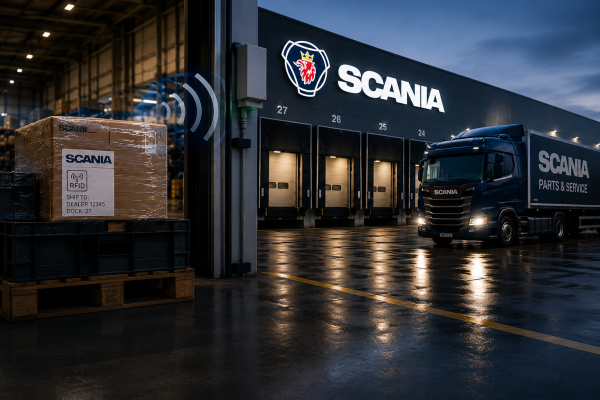
Achieving 99.8% outbound logistics accuracy with RFID
Every day, thousands of spare parts leave Scania's Global Parts Center in Belgium for dealers and distributors across Europe. In an operation of this scale, even a small loading error can result in delays, additional transport costs and unnecessary manual work.
To improve visibility and virtually eliminate shipping errors, Scania partnered with Mieloo & Alexander to implement an RFID-based real-time tracking solution for its outbound logistics process.
The challenge
Scania's spare parts distribution centre processes more than 26,000 shipments every day. Keeping track of every shipment while ensuring it reaches the correct loading dock is a complex logistical challenge.
Traditional barcode scanning required manual intervention and provided only limited visibility into the movement of goods throughout the warehouse. When shipments were misplaced or loaded onto the wrong truck, employees had to spend valuable time locating the correct items, impacting operational efficiency and delivery performance.
Scania wanted to:
- Increase shipment accuracy
- Gain real-time visibility into outbound logistics
- Reduce manual scanning and searching
- Minimise loading errors
- Improve delivery reliability for dealers and customers
The solution
Together with Mieloo & Alexander, Scania implemented an RFID-powered tracking solution that automatically identifies and monitors every shipment throughout the outbound process.
Each handling unit receives an RFID-enabled shipping label. As shipments move through the warehouse, strategically positioned RFID readers automatically capture their location without requiring manual scans.
The RFID platform provides warehouse employees with real-time insight into:
- The exact location of every shipment
- The correct loading dock
- Shipment status throughout the outbound process
- Potential exceptions before trucks leave the warehouse
By digitising the outbound flow, Scania created complete visibility across its shipping operation while significantly reducing manual handling.