

Mieloo and Alexander
  • 14 Apr 2026

Real-time medication inventory and expiry visibility with RFID

How hospitals can improve medication availability, reduce waste and gain complete inventory visibility from central pharmacy to the ward.

Hospital RFID Asset Tracking

Hospitals need reliable control over medication availability and expiry status across the full internal supply chain. In practice, medication logistics still depend heavily on manual checks and delayed updates, especially in the handover between the central pharmacy and ward medication rooms. Stock levels are often based on periodic counts rather than continuous data, which makes it difficult to spot shortages, deviations or expiring medication before they become a problem.

RFID changes this by enabling real-time insight into medication inventories and expiry status, from the central pharmacy all the way to the ward medication room, and increasingly across the inventories of multiple hospitals as well.

Why medication logistics need real-time visibility

The core challenge in hospital medication logistics is not a lack of data, but a lack of current data. Stock counts, expiry checks and replenishment decisions are frequently based on manual registrations that quickly become outdated. This leads to a familiar set of problems: differences between what is ordered and what is actually delivered, medication that expires unnoticed, ward staff spending time on manual counts, and limited visibility for the central pharmacy into what is actually happening at ward level.

RFID addresses this at the source. Instead of relying on people to register stock movements, RFID tags and readers register them automatically, at item level, the moment a movement takes place. That shifts medication logistics from periodic snapshots to a continuous, real-time picture of what is in stock, where it is, and how long it remains usable.

A connected RFID workflow, from goods receiving to ward consumption

A modern RFID-enabled medication flow connects every step between the pharmacy and the ward into a single, automated process rather than a series of disconnected manual checks.

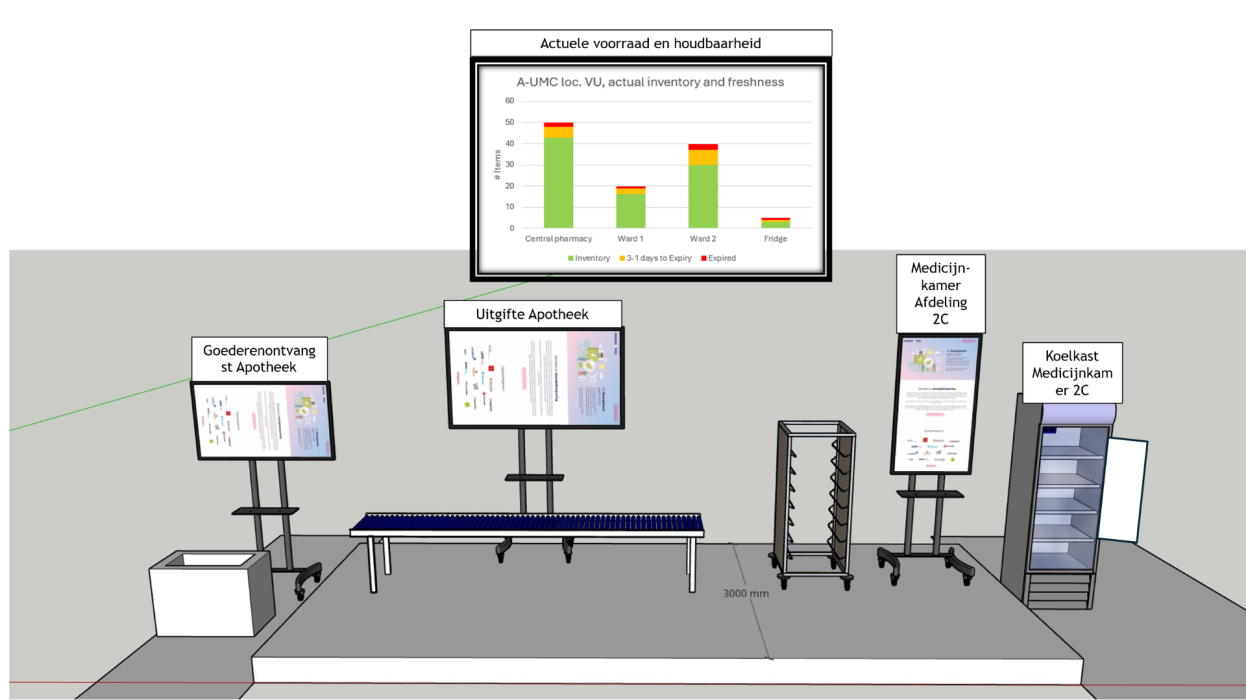
It starts at goods receiving, where medication crates delivered by the wholesaler are placed in an RFID scan bin and automatically compared against the original order. Deviations between what was ordered and what was actually delivered are identified immediately, and confirmed items are added to RFID-based stock without manual data entry.

From there, replenishment to the wards is registered just as automatically. Crates intended for ward replenishment are placed on a conveyor lane and booked as issued via an RFID reader, so pharmacy stock updates in real time the moment medication leaves the building, rather than after the fact.

At ward level, inventory counting and consumption registration become significantly faster. Ward stock can be scanned in one pass with an RFID handheld, immediately reflecting both replenishments and what has already been consumed, without the time-consuming manual counts that ward staff would otherwise need to perform.
 

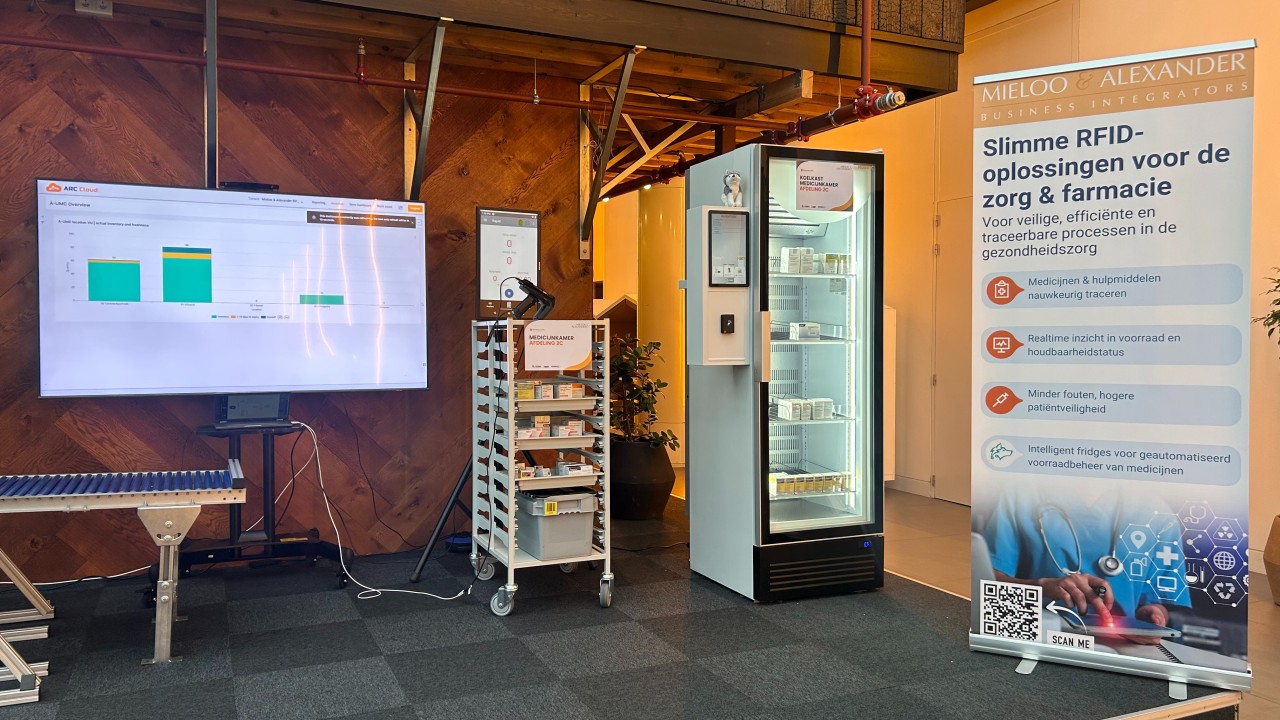
Storage itself becomes part of the same connected system through intelligent, RFID-enabled medication fridges for both pharmacy and wards. Built-in RFID readers automatically register which medications are used and which are replenished, continuously and remotely, so stock and expiry data stay current even inside cold storage.

All of this comes together through software that turns individual RFID reads into a usable, real-time picture. Because every solution in the workflow is connected to a shared RFID software platform, hospitals gain dynamic, real-time insight into medication stock and expiry status across pharmacy and wards, at any given moment, rather than only at the time of the last manual count. That same data foundation makes it possible, in principle, to share inventory visibility across hospitals as well, which can help address regional medication shortages before they become critical.

What hospitals gain from an integrated approach

Bringing these RFID solutions together into one connected workflow delivers a set of concrete operational benefits:

  • Real-time visibility of medication inventory and expiry status
  • Very fast and efficient registration processes at goods receiving, replenishment and ward level
  • Immediate insight into deviations between ordering and delivery
  • Automatic alerts on approaching expiry dates
  • Easy integration with EPD or ERP systems already in use
  • The ability to share and obtain real-time visibility into inventories of other hospitals

For pharmacy teams, this means less time spent on manual registration and more confidence that the data they act on reflects the actual physical stock. For ward staff, it means faster counts and fewer disruptions from unexpected shortages. And for hospital management, it means a clearer, real-time view of medication logistics as a whole, which supports both operational decisions and compliance requirements around traceability and expiry management. This connects closely to how RFID is already applied more broadly in medication inventory management across pharmacy and ward operations.

Built on proven RFID technology and software

This kind of connected medication logistics is only possible when hardware, software and integration come together as one solution rather than separate components. Mieloo & Alexander Business Integrators build these RFID workflows together with technology partners Husky Intelligent Fridges and Zebra Technologies, combining RFID, vision and IoT hardware with the ARC Suite cloud middleware platform. This includes advising on the right hardware and system design, implementation, and ongoing 24/7 support, so that hospitals get a solution built for daily operational reality rather than a one-off pilot.

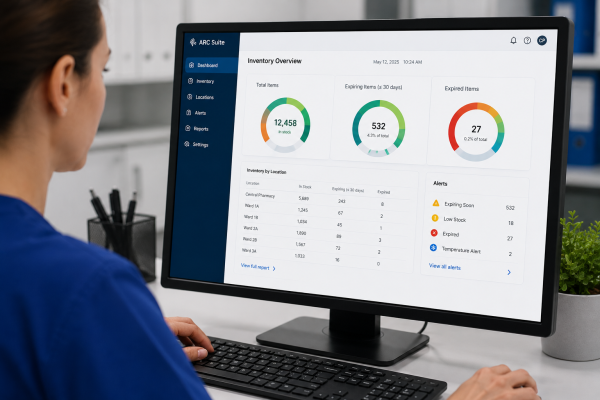
An example of what this looks like in practice is the actual inventory and freshness dashboard used at Amsterdam UMC, location VU, which shows live medication stock and expiry status across the connected workflow described above.


Ready to improve medication logistics in your hospital?

We are happy to map your current medication flow and outline what a pilot for pharmacy and wards could look like in practice.

Get in touch